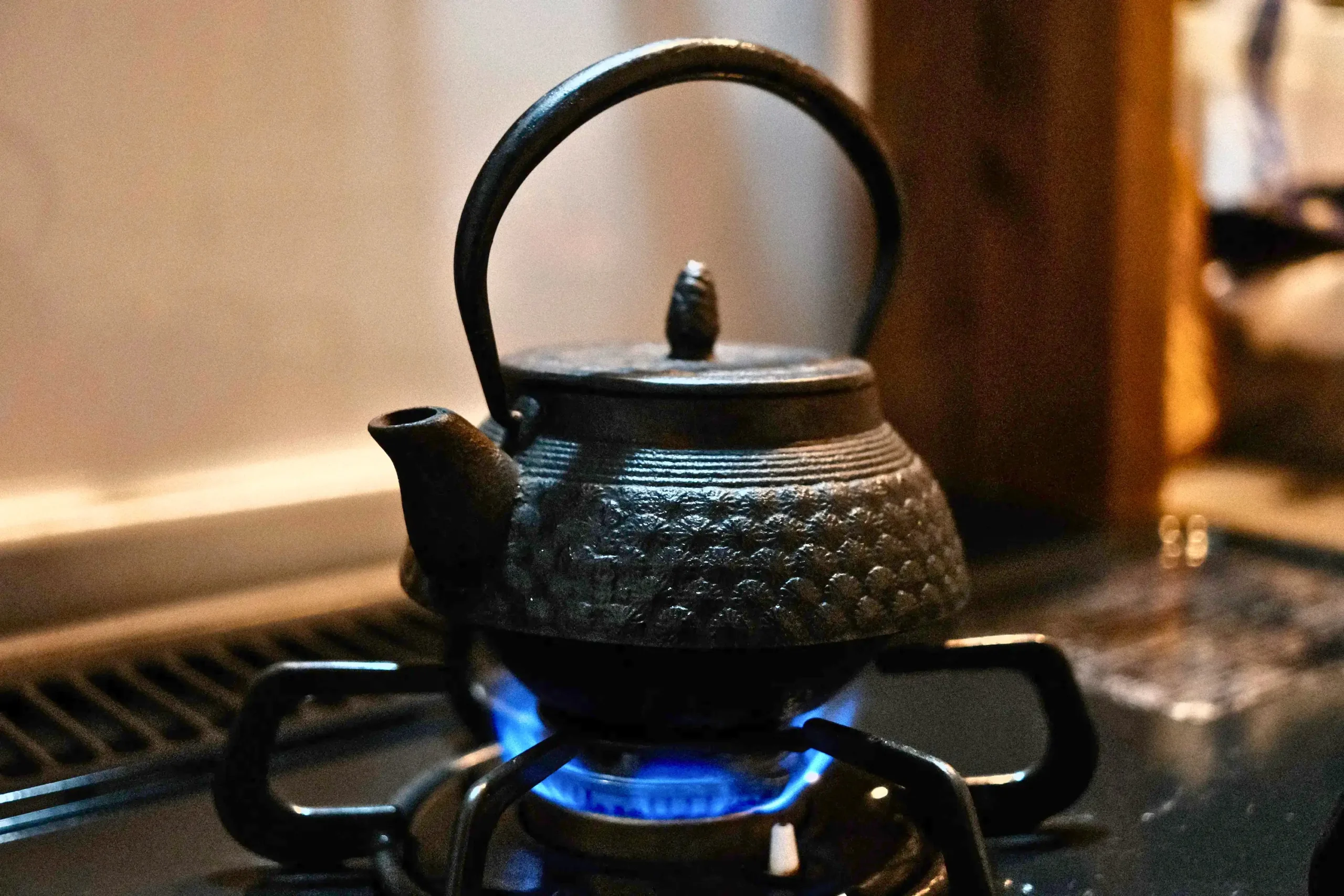
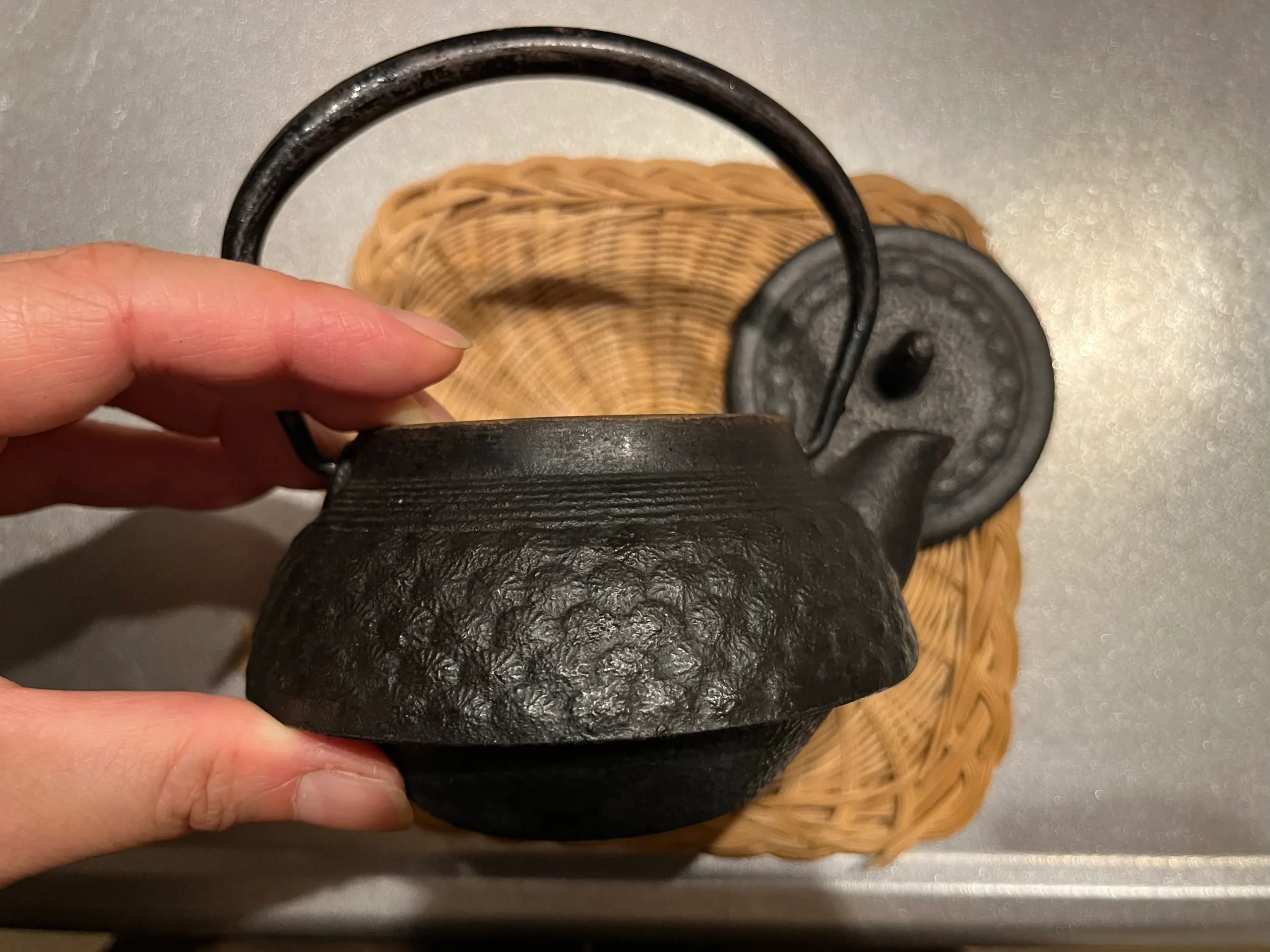
The iron kettle I use each morning belonged to my grandfather. I’ve known it since I was a child — it was always there in his kitchen, and now it’s mine. I don’t know who made it, or how old it is. Each morning, I use it to boil water: usually for sayu, plain hot water, but also for coffee and tea.
It’s a tetsubin, and it’s often confused with the cast-iron teapot it resembles. So here is what it actually is, the water it makes, and — the part most guides skip — how to use one, keep it, and bring it back when rust appears.
- What is a tetsubin?
- Tetsubin vs. tetsu-kyusu — the confusion
- The water it makes
- Does a tetsubin add iron?
- Using one, day to day
- How to clean and care for a tetsubin
- How to fix tetsubin rust (and cloudy or off-tasting water)
- Buying a real one — what to look for
- A few quick questions
- Why I keep using it
- More from the same shelf
What is a tetsubin?
A tetsubin is a Japanese cast-iron kettle for boiling water over direct heat. Its interior is bare, unglazed iron, and it’s made to sit right on the flame — a gas burner, a charcoal fire, or an induction cooktop if the kettle is built for one. Many good ones are made in the Nanbu tekki tradition of Iwate, in northern Japan, where iron has been cast since the 1600s. I don’t know whether mine is one of them; it carries no mark I can read. My mother uses a slightly larger one at the family home.
Tetsubin vs. tetsu-kyusu — the confusion
This is where people get mixed up — the tetsubin vs. kyusu question. Search for a tetsubin and you’ll mostly see small cast-iron teapots, often Chinese, sometimes labeled a “Japanese tea kettle.” Those are a different thing.
A tetsu-kyusu — a cast-iron teapot — has an enamel-coated interior, and it’s made for brewing tea, not heating it. Because of that lining, it must never go on direct heat. A tetsubin is the opposite: bare iron, meant for the flame, meant to boil. In short: a tetsubin heats the water; a kyusu brews the tea. (I do sometimes brew tea in mine, but boiling is what it’s really for.)
When you’re shopping, that lining is the tell. A bare, matte-gray iron interior is a tetsubin. A smooth, often colored, enamel interior is a kyusu — a teapot — and should never go on the stove.
The water it makes
The thing I notice most is the water. Water boiled in a bare-iron tetsubin tastes softer and rounder than ordinary hot water. The iron reacts gently with the water as it heats; it’s said to ease the harshness of chlorinated tap water and add a trace of iron. It also seems to stay warm longer. I don’t boil water quickly in it — I boil it slowly.
Does a tetsubin add iron?
This is where the tetsubin’s reputation comes from. It has long been said that a bare-iron kettle adds a little iron to the water you boil in it, and that is one of the reasons I use mine. Taking a little iron this way — from an old kettle and a cup of hot water — feels like a gentle, everyday way to do it.
Using one, day to day
Mine lives on the stove and gets used every day. My own small ritual is the morning cup: first thing, I drink sayu with a little cardamom and a clove or two, and I sip it slowly while the house is quiet. Boiling that one cup in the tetsubin takes longer than an electric kettle would, and that is the point — it gives me a few slow minutes I wouldn’t take otherwise. The rest of the day it boils water for coffee and tea.
I use mine on a gas flame, which is what most traditional tetsubin are made for. If you cook on induction, check before you buy: some newer tetsubin have a flat, induction-ready base, but many older ones — mine, most likely — are meant for gas or charcoal.
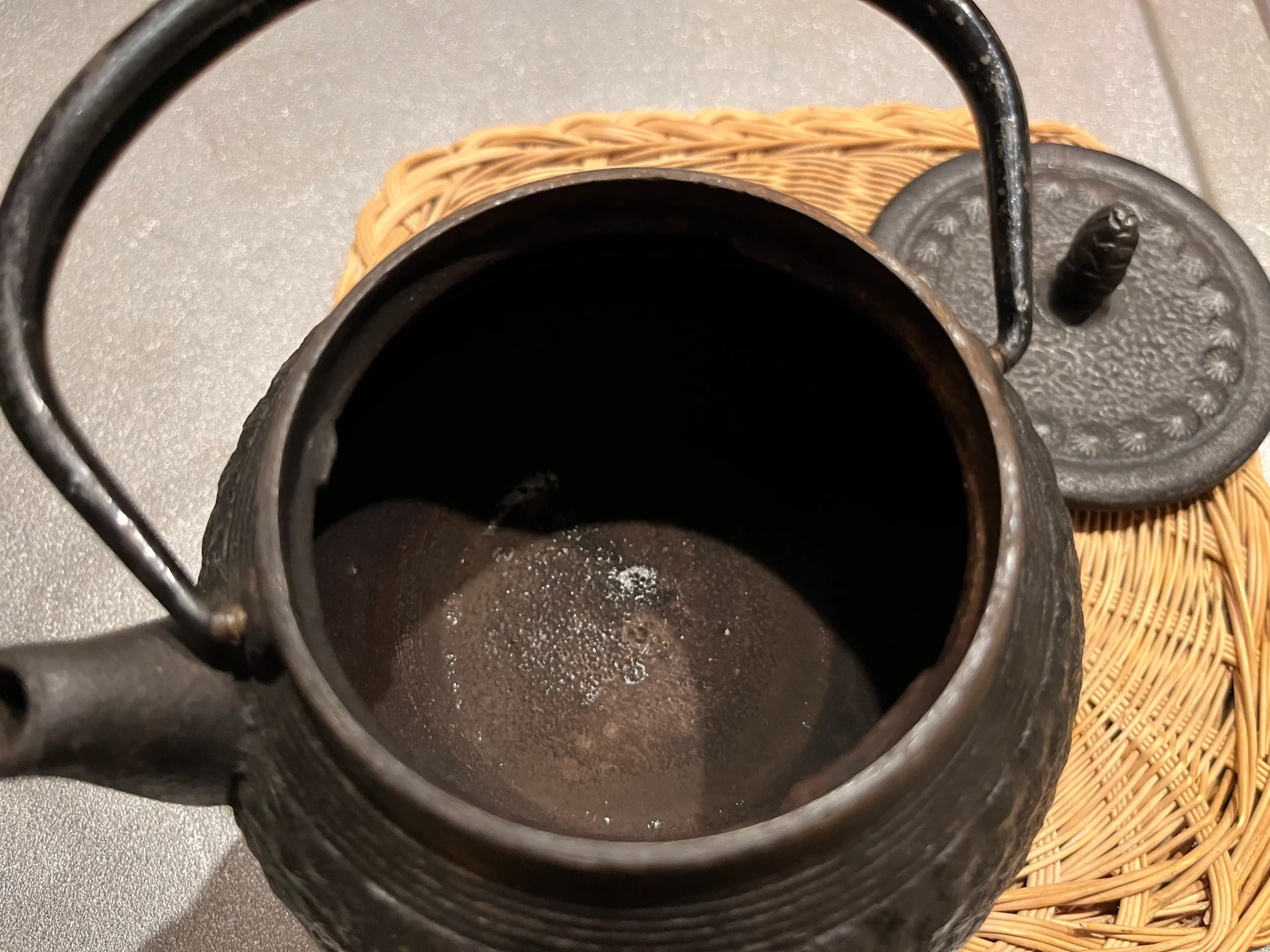
One thing to expect with a new kettle: a short breaking-in period. Over the first couple of weeks of use, a pale, chalky layer slowly forms on the inside — mineral scale left by the water. Don’t scrub it off. That layer, called yuaka, is a good thing: it shields the iron from rust and helps the water taste. Mine built up long before the kettle reached me, and I’ve simply left it alone ever since.
How to clean and care for a tetsubin
Day-to-day care is genuinely minimal, but two rules matter.
Never use soap. The inside of a tetsubin should never meet detergent, a sponge, or a scrubber — they strip away the seasoning and the mineral layer that protect it. After I boil, I rinse the inside with hot water, pour it all out, and wipe the outside with a cloth. That’s the whole routine.
Dry it completely, every time. This is the one habit that keeps rust away. Empty out all the water while the kettle is still warm, and leave the lid off so the last of the moisture steams itself away; the residual heat does the drying for you.
I don’t always manage it. I’ve left water standing in mine overnight and found spots of rust the next morning. It’s an easy thing to forget, and drying it can feel like a small chore — but it’s the difference between a kettle that lasts and one that pits.
How to fix tetsubin rust (and cloudy or off-tasting water)
Rust will appear eventually, especially if you slip up on the drying — and here the tetsubin is more forgiving than it looks. Don’t panic, and don’t scrub the inside bare. The traditional fix, and the one I use, is green tea.
I put a handful of green tea leaves into the kettle, fill it with water, and let it simmer for a while. The tannins in the tea react with the iron, darken the rust, and settle both the color and the taste of the water. After a treatment or two, the water runs clear again. I use the same method whenever the water comes out cloudy, or tastes even slightly off.
Buying a real one — what to look for
Mine was handed down, so I’ve never had to shop for one. If you are, the whole trick is not to buy the wrong object. A few things to check:
- A bare cast-iron interior. A true tetsubin is uncoated inside — matte gray iron. A smooth, enamel-lined interior (often colored) is a tetsu-kyusu, a teapot, and must not go on the stove.
- Rated for direct heat. It should clearly say it can go on the flame.
- Gas, charcoal, or induction. Most traditional pieces are for gas or charcoal; if you cook on induction, look for an induction-ready base.
- Nanbu tekki. A piece from the Nanbu ironware tradition of Iwate is a reliable mark of the real thing.
Choose it for the inside, not the color.
A few quick questions
Does a tetsubin really add iron?
It’s long been said that a bare-iron kettle adds a trace of iron to the water, and it’s one of the reasons I use mine — but treat it as old wisdom, not a health plan.
Can I clean it with soap?
No. Hot water only inside, a cloth for the outside. Soap strips what protects the iron.
There’s a white, chalky layer inside — is it dirty?
No. That’s yuaka, a mineral layer that builds up with use. Leave it; it guards against rust and helps the water taste.
Can I use it on an induction cooktop?
Only if it’s made for one. Many traditional tetsubin, older ones especially, are for gas or charcoal.
Tetsubin or kyusu — which do I want?
A tetsubin boils water on the flame. A tetsu-kyusu, enamel-lined, brews tea and must never go on heat.
Why I keep using it
An electric kettle would be faster. I keep using my grandfather’s tetsubin because I like the slower way of doing things — and because it was his.
Sources & further reading

Yasuko
I first trained as a natural-food coordinator, out of an interest in Japanese food and home; these days I work as a photographer and web designer in Japan. I write about the everyday Japanese tools I keep and use at home — with seven rescued cats never far away.
One quiet note a month
New tools, seasonal handwork, and the cats — a short letter when there’s something worth sharing. No noise.
Unsubscribe anytime. Roughly once a month.